
Best Word Party Games for 4-8 Players (2026)
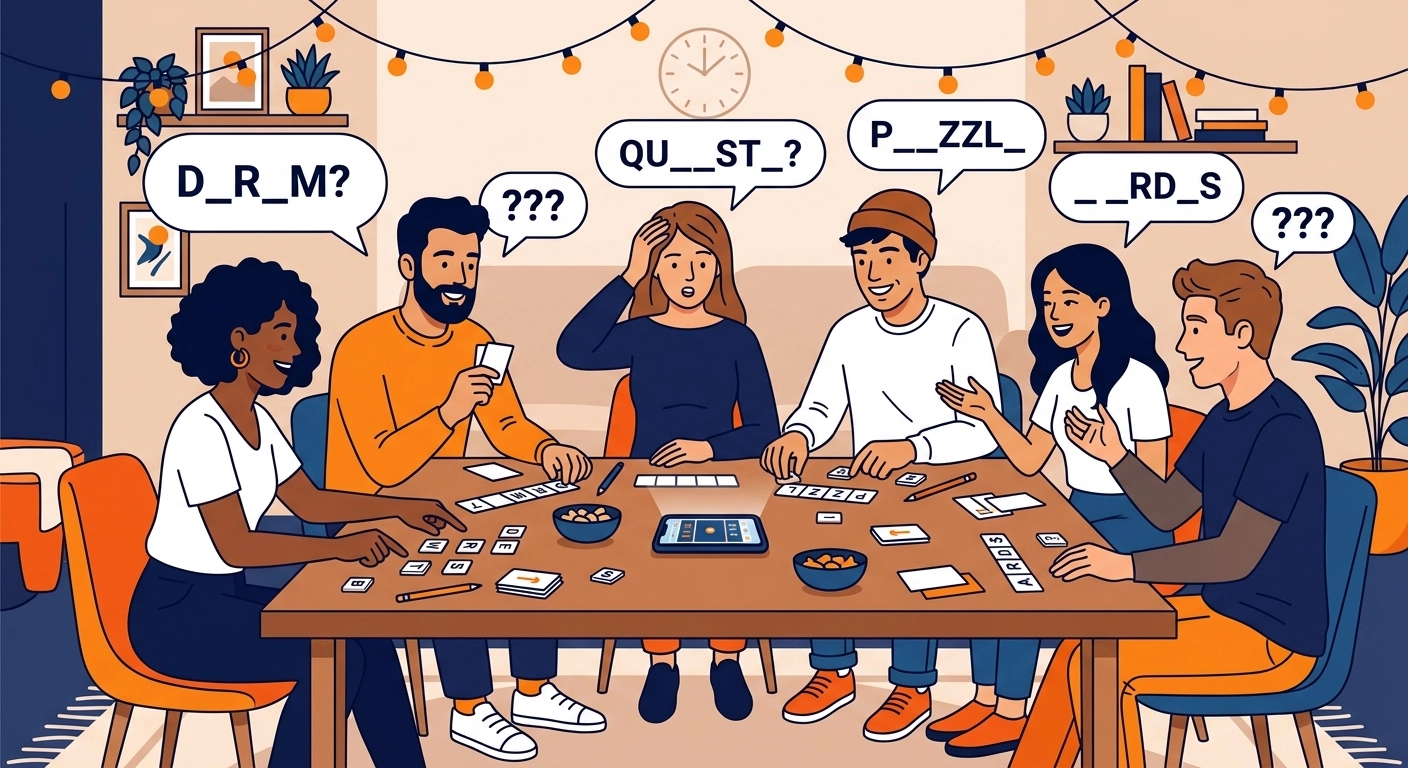
Looking for word party games that actually work with a small group? You don't need a dozen people or a shelf full of equipment. The best word party games in 2026 are designed for groups of 4–8 players and can turn any living room, backyard, or road trip into a proper game night. We tested apps, board games, and hybrid options to find the seven that deliver the most fun per minute.
Quick Navigation
Why Word Games Dominate Game Night
Word party games have stayed popular for decades, and 2026 is no different. They're easy to explain, impossible to outgrow, and they scale beautifully for groups of 4–8. Unlike trivia games that punish you for not knowing random facts, word games reward creativity, bluffing, and quick thinking—skills everyone already has.
The sweet spot for word party games is 4–8 players. Enough people for team-based play, small enough that everyone stays engaged. No one sits on the sideline scrolling their phone, and turns come around fast. That balance is exactly what makes these seven games stand out.
Whether you prefer a physical board game spread across the table or a single app on your phone, the word games on this list cover both. We've mixed classic tabletop picks with modern digital options so you can build a game night that fits your group's vibe.
The 7 Best Word Party Games for 4–8 Players
1. Codenames
Codenames is the gold standard for team-based word party games. Two teams compete to identify their agents from a grid of 25 words using one-word clues from their spymaster. The tension of linking multiple words with a single clue creates "aha" moments that keep the table buzzing. It's the kind of game where you'll argue about clue quality for days afterward. The Duet version also works brilliantly for smaller groups who prefer co-op over competition.
Strengths
Incredible replay value, easy to teach in 2 minutes, multiple versions available (Pictures, Duet, Deep Undercover)
Weaknesses
Spymaster role can feel stressful, needs at least 4 players to work well, physical version requires table space
2. Impostor Who?
Impostor Who? blends word games with social deduction. Everyone gets a secret word on the same phone—except the impostor, who gets a different word or nothing at all. Players give one-word hints and try to figure out who doesn't belong, while the impostor tries to blend in. It's a word party game that doubles as a bluffing game, and the discussions get genuinely heated. With over 2,000 words across 11 categories, it stays fresh across dozens of sessions.
Strengths
Works on a single phone with no internet, supports 3–20 players, free to play, six languages
Weaknesses
Requires honest pass-and-play (no peeking), the impostor role can feel intimidating for shy players
3. Taboo
Taboo forces you to describe a word without using the five most obvious clue words. That constraint is what makes it so entertaining—watching someone try to get their team to say "beach" without saying sand, ocean, water, sun, or swim. It's a classic word party game that rewards quick thinking and creative descriptions. The buzzer adds time pressure, and the "taboo" words keep every round feeling different even with familiar topics.
Strengths
Fast-paced and loud, great for competitive groups, massive card library in newer editions
Weaknesses
Needs even team splits, can be tough for non-native English speakers, physical game only
4. Articulate
Articulate is the fast-talking description game where you describe as many words as possible before the timer runs out. Unlike Taboo, there are no banned words—you just can't say any part of the word itself. Categories rotate between nature, world, people, action, object, and random, keeping every turn unpredictable. It's one of those word party games that reveals how differently people think, and the board-game format with team progression adds a satisfying competitive arc.
Strengths
High energy, great for couples or team pairs, category variety keeps it fresh
Weaknesses
Board game only (no app), needs even team numbers, some cards feel dated in newer editions
5. Just One
Just One won the Spiel des Jahres (Game of the Year) for good reason. It's a cooperative word party game where everyone writes a one-word clue to help the guesser identify the mystery word—but identical clues get cancelled. That simple twist creates genuine strategy: do you play it safe with an obvious clue, or go niche and risk being the only one with a useful hint? The cooperative format means no one loses, which makes it perfect for mixed groups of competitive and casual players.
Strengths
Cooperative (no losers), extremely simple rules, award-winning design, great for mixed groups
Weaknesses
Needs dry-erase markers and easels (included), less exciting for highly competitive groups, no app version
6. Wavelength
Wavelength asks a deceptively simple question: where does a concept fall on a spectrum? One player sees a hidden target on a dial between two extremes—like "Hot ↔ Cold"—and gives a single word clue. The rest of the team debates where on that spectrum the clue lands. It's technically a word game, but it plays more like a mind-reading experiment. The arguments it sparks ("Is pizza more hot or cold?") are half the fun of this word party game.
Strengths
Unique mechanic, sparks amazing debates, beautiful physical component, free online version available
Weaknesses
Scoring can feel arbitrary, less word-focused than others on this list, dial device can be fragile
7. Werewords
Werewords combines 20 Questions with Werewolf. The mayor picks a secret word, and the village asks yes-or-no questions to guess it—but a hidden werewolf is secretly trying to derail the group without getting caught. Meanwhile, a seer knows the word and tries to guide the group subtly. It's a clever mash-up that adds social deduction tension to a simple word-guessing format. The free app handles all the role assignments and timers, making setup effortless.
Strengths
Unique word + deduction hybrid, free companion app, quick rounds, works with 4–10 players
Weaknesses
Mayor role is passive, can feel chaotic with large groups, the word difficulty varies wildly
Quick Comparison
| Game | Players | Time | Type | Price |
|---|---|---|---|---|
| Codenames | 4–8+ | 15 min | Board / App | $20 / Free |
| Impostor Who? | 3–20 | 10 min | App | Free |
| Taboo | 4–10+ | 20 min | Board | ~$20 |
| Articulate | 4–8+ | 30 min | Board | ~$30 |
| Just One | 3–7 | 20 min | Board | ~$25 |
| Wavelength | 2–12 | 30 min | Board / Web | $40 / Free |
| Werewords | 4–10 | 10 min | Board / App | ~$15 / Free |
Game Night Setup Tips
A great word party game deserves a great setup. These tips will help you host a game night that people actually want to come back to.
Plan Your Game Order
Start with something light and cooperative like Just One as a warm-up. Move into competitive team games like Codenames or Taboo in the middle. End with something social and casual like Impostor Who? or Wavelength when energy is winding down.
Keep Groups at 4–8
Most word party games hit their stride with 4–8 players. Bigger groups mean longer waits between turns. If you have 10+ people, split into two groups playing different games and rotate halfway through the night.
Mix Apps and Board Games
Alternating between phone-based word games and physical board games keeps the energy varied. An app game like Impostor Who? needs zero setup, making it a perfect palette cleanser between longer board games.
Set a Timer Between Games
Give people 5–10 minutes between games for snacks, drinks, and bathroom breaks. Sounds basic, but back-to-back games without breathing room burns people out faster than you'd expect.
Download Apps Ahead of Time
If you're using app-based games, download them before guests arrive. There's nothing worse than everyone standing around while you wait for an install. Games like Impostor Who? and Werewords work offline, so you don't even need Wi-Fi.
Have a "New Player" Rule
If someone hasn't played before, do a practice round that doesn't count. Word party games are easy to learn, but a zero-stakes warm-up round helps newcomers relax and actually enjoy themselves.
Frequently Asked Questions
What are the best word party games for adults?
For adults, Codenames, Wavelength, and Impostor Who? are top picks. They reward strategic thinking and creative communication without relying on knowledge- based trivia. Taboo and Articulate are also great if your group enjoys high-energy, fast-paced rounds.
Can you play word party games with just 4 people?
Absolutely. Every game on this list works with 4 players. Codenames plays well with two teams of two, Just One works cooperatively at any count above 3, and Impostor Who? starts at just 3 players. You don't need a big group to have a good time with word games.
What's the best free word party game app?
Impostor Who? is completely free, works on a single phone with no internet, and supports up to 20 players. Werewords also has a free companion app. Codenames has a free online version at codenames.game that works well for remote play.
Are word party games good for family game night?
Yes, most word party games are family-friendly. Just One and Codenames work with ages 10 and up. Impostor Who? is also great for families since the word categories are clean and the rules are simple enough for younger teens. Avoid the "adult" editions of Taboo for family nights.
How long does a typical word game night last?
Plan for 2–3 hours. Most word party games run 10–30 minutes per round, so you can easily fit 3–4 different games into one evening. If you're mixing board games and app games with breaks in between, three hours is the sweet spot before fatigue sets in.
The Bottom Line
Word party games remain some of the most accessible, replayable, and consistently fun games you can bring to a gathering. Whether you go all-in on a board game like Codenames or keep things minimal with a phone app like Impostor Who?, the key is matching the game to your group's personality.
For competitive groups: Taboo and Articulate deliver high-energy team battles. For chill vibes: Just One and Wavelength keep things cooperative and low-pressure. For something in between: Codenames, Impostor Who?, and Werewords blend strategy with social dynamics.
Pick two or three from this list, invite 4–8 friends, and you've got everything you need for a word party game night worth remembering.
Try Impostor Who? at Your Next Game Night
One phone, 3–20 players, zero internet required. A word party game that doubles as a social deduction thriller.
Download FreeRelated Articles
Word Games That Will Challenge Your Friends: From Wordle to Party Classics
Discover the best word games for parties and gatherings. From Wordle-inspired challenges to classic free word games, find the perfect games to test your vocabulary with friends.
Read MoreCozy Winter Party Games for Indoor Gatherings
Cold weather keeping everyone inside? Perfect. These cozy winter party games turn indoor gatherings into unforgettable experiences. No outdoor activities needed.
Read More
10 Hilarious Ice Breaker Games for Any Party (2026)
Break the ice at any gathering with these 10 hilarious party games. From quick phone games to classic crowd favorites — tested and ranked for 2026.
Read More